When you write your first eBPF tool — whether it’s capturing logs, emitting performance events, generating security alerts, or building an observability pipeline — timestamping events feels trivial. Call bpf_ktime_get_ns(), store the result in your event struct, ship it out the ring buffer. Done.
Then you try to correlate those events with the outside world and discover the timestamps are nonsense — off by days, weeks, or the entire uptime of the machine. The numbers are technically precise; they’re just measuring the wrong thing.
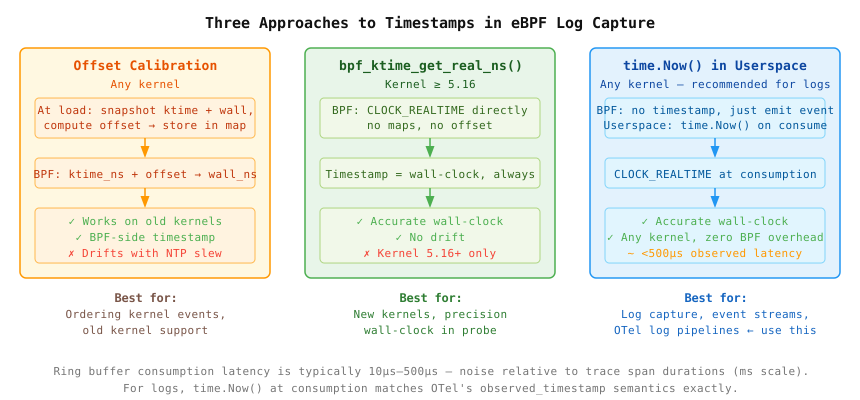
This post traces bpf_ktime_get_ns() all the way down to the kernel clock source, explains three approaches to getting usable wall-clock time in eBPF, and builds a decision tree for which one to use.
What bpf_ktime_get_ns() Actually Returns
bpf_ktime_get_ns() is a thin wrapper around the kernel’s ktime_get_ns(), which operates on the CLOCK_MONOTONIC domain.
CLOCK_MONOTONIC is defined in POSIX as a clock that:
- Never goes backward
- Has no defined relationship to wall-clock time
- Starts at an arbitrary point (typically system boot, but not guaranteed by the spec)
In practice on Linux, it starts at boot and runs forward. After 47 days of uptime, bpf_ktime_get_ns() returns roughly 4,060,800,000,000,000 nanoseconds. That’s not a Unix timestamp — it’s a duration since boot.
If you try to use it as a Unix timestamp, you’ll get dates in 1970 (for short uptimes) or wildly wrong values for any non-trivial uptime. Correlating with traces that use CLOCK_REALTIME-based timestamps (which is what every tracing SDK, OpenTelemetry, and Jaeger uses) is simply not possible without conversion.
There are a few other BPF time helpers worth knowing:
| Helper | Clock domain | Notes |
|---|---|---|
bpf_ktime_get_ns() |
CLOCK_MONOTONIC |
No wall-clock relation |
bpf_ktime_get_coarse_ns() |
CLOCK_MONOTONIC_COARSE |
Lower precision, faster |
bpf_ktime_get_boot_ns() |
CLOCK_BOOTTIME |
Includes time suspended |
bpf_ktime_get_tai_ns() |
CLOCK_TAI |
Kernel 5.16+, atomic time, no leap smearing |
bpf_ktime_get_real_ns() |
CLOCK_REALTIME |
Wall-clock, kernel 5.16+ |
bpf_ktime_get_real_ns() is the obvious answer — it’s CLOCK_REALTIME directly from BPF. But it requires kernel 5.16+, released in January 2022. If you need to support older kernels (enterprise Linux distros, many cloud providers), you need a different approach.
Three Approaches
Approach 1: BPF-Side Timestamp with Offset Calibration
Load time: snapshot both the monotonic clock and wall-clock time from userspace, compute an offset, store it in a BPF map. The probe adds the offset to bpf_ktime_get_ns() to approximate wall-clock time.
// At BPF load time
func computeKtimeOffset() int64 {
    // Sample multiple times and take the tightest pair
    // to minimize the race between the two reads
    var minGap int64 = math.MaxInt64
    var bestOffset int64

    for i := 0; i < 10; i++ {
        before := time.Now().UnixNano()
        ktime := readKtimeNs()  // read via /proc/timer_list or a one-shot BPF call
        after := time.Now().UnixNano()

        gap := after - before
        if gap < minGap {
            minGap = gap
            // Approximate: ktime was read at the midpoint
            bestOffset = (before+after)/2 - ktime
        }
    }
    return bestOffset
}
Store bestOffset in a BPF map (a single-entry array map works). In the probe:
u64 ktime_ns = bpf_ktime_get_ns();
u64 *offset  = bpf_map_lookup_elem(&ktime_offset_map, &zero);
u64 wall_ns  = offset ? ktime_ns + *offset : ktime_ns;
This is what Falco does, and what several Cilium features use. It works — with caveats.
Why it drifts.
NTP and the kernel’s adjtime() can slew CLOCK_REALTIME by up to 500 parts per million (ppm) to correct for clock drift. Over 24 hours at maximum slew, that’s ~43 milliseconds of accumulated error. The offset you computed at load time becomes stale.
Virtualized environments make this worse. With kvm-clock as the clock source, the guest’s monotonic clock is disciplined by the hypervisor, not by NTP. The relationship between CLOCK_MONOTONIC and CLOCK_REALTIME in the guest can drift independently.
When it’s acceptable.
For coarse observability — dashboards, alerting, log search with second-level granularity — a few milliseconds of drift is fine. If you need sub-millisecond timestamp accuracy and must support kernels before 5.16, this is the best you can do from BPF.
You can mitigate drift by periodically re-calibrating the offset from userspace (every few minutes) and updating the BPF map. The probe always reads the latest value.
Approach 2: bpf_ktime_get_real_ns() (Kernel 5.16+)
If your minimum kernel is 5.16, this is the clean solution. It reads CLOCK_REALTIME directly from BPF — the same clock source that time.Now() uses in Go, System.currentTimeMillis() in Java, and every tracing SDK.
u64 wall_ns = bpf_ktime_get_real_ns();
No offset, no drift, no calibration. The timestamp is directly comparable to trace spans.
The only gotcha: CLOCK_REALTIME can go backward if NTP makes a step correction (as opposed to a slew). For monotonic ordering of events within a single capture session, combine it with bpf_ktime_get_ns() for ordering and bpf_ktime_get_real_ns() for the display timestamp.
Approach 3: Timestamp in Userspace at Ring Buffer Consumption
For log capture specifically, skip BPF-side timestamping entirely. Emit the log event from the ring buffer without a timestamp, and call time.Now() in userspace when the event is consumed.
func (lc *LogCollector) processEvents(ctx context.Context) {
    for {
        record, err := lc.reader.Read()
        // ...

        // Timestamp here, not in BPF
        now := time.Now()

        var event LogEvent
        binary.Read(bytes.NewReader(record.RawSample), binary.LittleEndian, &event)

        rec.SetTimestamp(now)
        rec.SetObservedTimestamp(now)
        // ...
    }
}
Why this is correct for logs.
The ring buffer is a shared memory region between kernel and userspace. When bpf_ringbuf_submit() is called in the probe, the event is immediately visible to userspace readers. Ring buffer consumption latency on a non-saturated system is typically 10µs–500µs.
For log-trace correlation, trace spans have millisecond-scale durations. A sub-millisecond timestamp error is noise. What you actually want semantically is “when was this log observed by the collection pipeline” — which is precisely what time.Now() at consumption time gives you. This matches the OTel log data model’s observed_timestamp field exactly.
The approach also sidesteps the 5.16 kernel requirement entirely and requires zero BPF map reads in the hot path.
When BPF-Side Timestamps Are the Right Answer
Everything above assumes you’re timestamping for display and correlation. Sometimes you need BPF-side timestamps for a different reason: measuring duration between two kernel events.
// In a kprobe on tcp_sendmsg
u64 send_ts = bpf_ktime_get_ns();
bpf_map_update_elem(&send_times, &sock_cookie, &send_ts, BPF_ANY);

// In a kprobe on tcp_ack received
u64 *send_ts = bpf_map_lookup_elem(&send_times, &sock_cookie);
u64 rtt_ns = bpf_ktime_get_ns() - *send_ts;
Here, bpf_ktime_get_ns() is exactly right. You’re computing a delta between two monotonic readings — the absolute value doesn’t matter, only the difference. Using bpf_ktime_get_real_ns() here would introduce NTP slew into your latency measurements, which is worse.
The rule: monotonic for deltas, real-time for display.
Decision Tree
Do you need wall-clock time (correlate with traces, display to humans)?
├── Yes
│   ├── Kernel >= 5.16?
│   │   ├── Yes → bpf_ktime_get_real_ns()
│   │   └── No → Offset calibration (re-calibrate every few minutes)
│   └── Is sub-ms accuracy required?
│       ├── No → time.Now() at ring buffer consumption (simplest, correct)
│       └── Yes → bpf_ktime_get_real_ns() or offset calibration
└── No (measuring duration between kernel events)
    └── bpf_ktime_get_ns() — monotonic delta, no conversion needed
For log capture on any kernel: time.Now() at consumption. You get wall-clock accuracy, no kernel version requirement, no BPF map overhead, and semantics that match what the OTel log spec actually calls for.
The timestamping approach described here is part of the eBPF instrumentation work happening at odigos-io.